


One of the oldest questions in economics is why some countries are rich and others poor. This was the central question that Adam Smith went about answering in The Wealth of Nations. But before economists can explain differences in prosperity, they first have to measure them. This is where we diverge from Smith who famously wrote: ‘I have no great faith in political arithmetic, computations’ (book IV, c. v). Smith was referring here to the practice since the time of William Petty of attempting to measure the wealth of nations.
Measuring the wealth of nations is harder than it sounds and despite it being the 250th anniversary of the Wealth of Nations, we are still seeing some controversies over how to measure the performance of countries (e.g., see debates between Paul Krugman and others on the relative decline of Europe vis-à-vis the US using constant/current PPP adjusted GDP).

Comparing national incomes across countries requires converting different currencies into a common unit while accounting for differences in prices, consumption patterns, and the large share of goods and services that are not internationally traded. Comparisons over time face different challenges, especially in the long run. How to compare national income for a country in 1900 vs. today when many of today’s goods didn’t exist a century ago? This is the ‘new goods’ problem that has plagued measurement since the 1990s. Various attempts have been made to address this such as using hedonic pricing.
In this substack, we look at two pioneers of comparative national accounts, Michael Mullhall and Angus Maddison, and at the very long run – millennium, thousand-year – picture. From this perspective, only one thing happened, namely the Industrial Revolution, and the interesting questions are why it happened when and where it did, and why it didn’t happen elsewhere before that.
In a follow-up substack, we will turn our attention to the medium run (or nearly long run?) – half a century or thereabouts. The trigger for this is the release of version 11 of the Penn World Tables (PWT) and what it has to say in particular about China’s rise over the last 50 years. Not to give the full punchline away, but we have doubts about not about what PWT 11.0 says China’s position in the global world economy today – this is indisputable – but about the starting point just prior to the reforms of 1978. Different interpretations of this starting point have big implications for interpreting what happened afterwards.
But first, some intellectual history. One of us took a deep dive into the long history of national accounting (McLaughlin 2026).
Michael Mullhall: 19th century pioneer in comparative national accounts
Michael Mulhall (1836-1900) published a series of cross-country estimates of wealth in various statistical books published between 1880 and 1896 (Mulhall 1880, 1881, 1884, 1892, 1896). Mulhall’s motives were simply that it is ‘important for us to know every ten years the progress made by nations in the various branches of industry and finances, as to take census of their population’, and that ‘it is unquestionably of the highest importance to ascertain approximately the earnings and wealth’ of nations.
Mulhall (1892) measurement of the Wealth of Nations
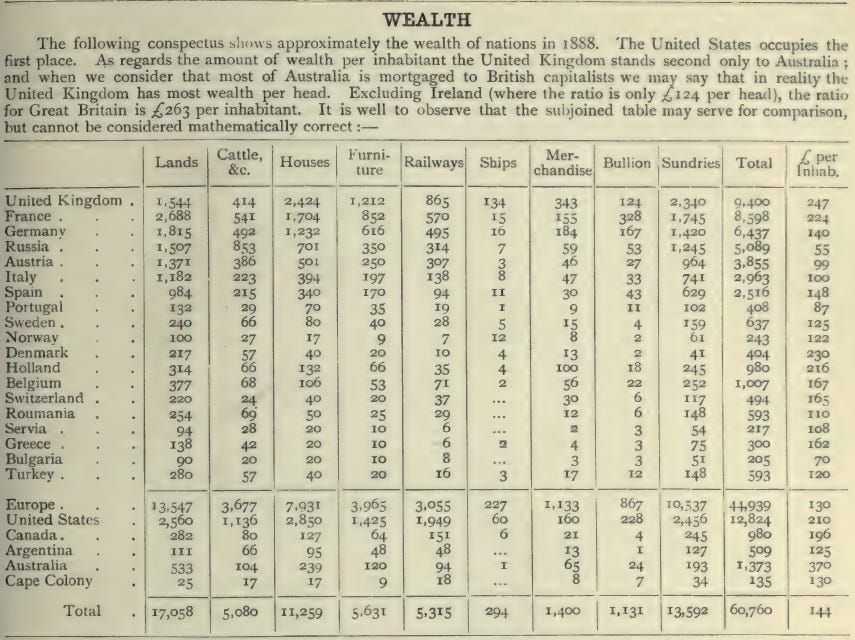
Mulhall’s approach was to find statistics, or estimates, from various countries and make comparisons. In his works he provided estimates of both the income of nations where he kept a distinction between income and capital (or ‘wealth of nations’). While earlier editions of the Dictionary of Statistics provided little in the way of commentary, the 1892 edition of the Dictionary included both income and wealth collated from a range of authors and based on his tabulations of land, livestock, houses, furniture, as well as infrastructure. From his compilation of data, Mulhall estimated that the US occupied first place followed by Australia and the United Kingdom. In Industry and Wealth (1896) Mulhall formally introduced his underlying methodology: it was a crude approximation of national income and wealth which appeared to arbitrarily assign income to different classes, but it was purported to have been applied across countries which made estimates consistent and comparable.
Mulhall’s work was not universally well received, although, as the economist Arthur Bowley (1869-1957) later reflected, the work ‘had its utility but (as Professor Alfred Marshall warned me) it was marred by the inclusion of extravagant guesses with ascertained facts’ (Bowley 1953). Mulhall’s work received scathing reviews in statistical journals primarily because of the lack of source attribution, with one anonymous reviewer writing that ‘the statistical specialist has long regarded with justifiable suspicion any statement which emanates from this writer’ and another remarking that it represented an ‘uncritical use of data’.[1] Nor were historians kind; Mulhall was ‘accused of guesswork, exaggeration, and gross inaccuracy’ and his casual approach of using pictures to represent various statistics was also lambasted as they contained ‘such inaccuracies as to leave the method in doubt’ (Funkhouser 1937).
A later edition of the Dictionary of Statistics compiled by the statistician August Webb (1880-1953) was much better received by critics, particularly because it was more thorough with its inclusion of the sources of the various statistical tables,[2] including estimates of national income and wealth for the United Kingdom based on work of the statistician and economist Robert Giffen (1837-1910) as well as a reference to previous estimates of UK national income (Giffen 1903).
While Mulhall’s work may not have been held in high esteem by his contemporaries, he was later lauded by Paul Studenski and Angus Maddison as being a pioneer in cross-country comparisons of national income and wealth. Part of the criticism of Mulhall can be seen as a misunderstanding of his purpose. From the perspective of a statistically focused reviewer, Mulhall had missed the point of the emerging discipline of statistics by extrapolating aggregates from averages because ‘the purpose of statistics is to ascertain typical conditions, not totals which are meaningless’.[3] Yet, it is the aggregate that modern macroeconomic measurement is concerned with rather than the average and so, while flawed, Mulhall’s exercises were precursors to aggregation (i.e., macro-measurement). Here then we see the contrast between statistics as a collection of information and ‘facts’ and statistics as a distinct methodological and analytical approach.
Angus Maddison: Long-run Chiffrephile
Angus Maddison (1926-2010), the famous compiler of historical GDP, saw political arithmetic as the antecedent to modern national income accounts. Maddison, who described himself as a chiffrephile (an enthusiast about data), was a pioneer in the estimation of historical national accounts. He studied at the University of Cambridge at the end of WWII, then the leading centre of economic measurement with the Nobel laureates James Meade and Richard Stone, and Maddison later worked in the economics division of the OEEC/OECD (Maddison 1994). Maddison’s original motivation for his historical work was to understand why growth differed among countries; especially during the so-called ‘Golden Age’ of high economic growth after WWII to 1972 (Maddison 1964). Maddison was then further motivated by the growth slowdown after 1973 in Western European countries (Maddison 1982) In later work, Maddison saw his efforts as a quantification of Adam Smith’s view of the world with a comparative perspective on why some countries were rich and others poor (Maddison 2001). For Maddison, an understanding of the contemporary economy was not possible without an understanding of the past. Maddison’s initial work was well respected, for example he was commended by Kenneth Boulding in a review in the journal Science in 1964.
In subsequent research, Maddison attempted to estimate GDP figures as far back as the year 1, but these were only for a small number of countries and the bulk of data was from the 1950s onwards (based on the post-WWII adoption of national accounts – see Maddison 2004). But some of these historical estimates should be treated more as informed conjectures rather than as firm quantitative evidence. Or rather, as Smil (2019) refers to them, as ‘qualitative impressions’. Others have been less kind and have highlighted the limitations in terms of the population numbers that Maddison relied on extensively (Guinnane 2023), while some have claimed that Maddison simply became bolder in the ‘mysteries of his craft’ (Clark 2009). In his final book, Maddison (2007) stressed that his work was an attempt to show how the world had gradually evolved during the mercantilist era and that there was no pre-1800 Malthusian trap.
When Angus Maddison died, his work was continued by colleagues at the University of Groningen. This work on historical GDP has continued to the present day by the Maddison Project which collects and collates data on GDP over time and space (Maddison 2001, Bolt & Van Zanden 2014). These data have been widely used by growth economists to study the dynamics of long-run growth (Deaton and Heston 2010). The most recent update of the Maddison Project has streamlined estimates of GDP across a more geographical diverse array of countries. One of the major contributions of this exercise has been identifying the timing of the ‘Great Divergence’ between Europe and Asia (Bolt and Van Zanden 2025).
The Long-Run Picture: Singularity1.0
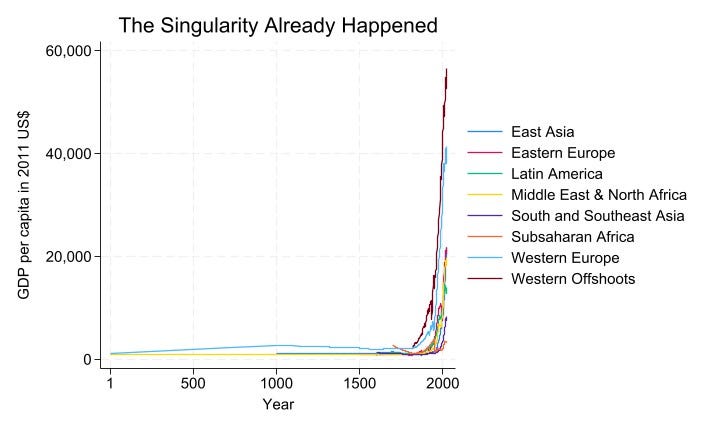
A single time-series graph of GDP per capita illustrates. We use the latest Maddison Project numbers and aggregate into 8 regions using the typology in the source data. The Big Picture is pretty obvious – as Brad DeLong (citing Cosma Shalizi) likes to say, the Singularity is in our past. In the Malthusian Era, living standards everywhere were very, very low. The graph starts at 1 AD but if we extended backwards as far humans existed – say, to ~2 million BC, when genus homo first emerges – the picture would change only in how sharp the divergence of the past few centuries has been compared to what came before.

The world today is, by the standards of all of human history, inconceivably rich, so much so that the term “singularity” is clearly warranted. Might as well quote Wikipedia here: ‘The technological singularity … is a hypothetical event in which technological growth accelerates beyond human control, producing unpredictable changes in human civilization.’ The only tweak needed is that the Industrial Revolution and modern economic growth aren’t ‘hypothetical’.
The interesting questions that the economic history community wrestle here are, for example, When did the take-off start? (see Bouscasse et al. (2025) for a recent take on this); Why was Britain and specifically England the initial centre of the Industrial Revolution and not elsewhere (see Allen (2009) & Mokyr (2009) for some competing theories)? Given the technological lead China had over Western Europe until the middle of the last millennium, why didn’t the Industrial Revolution start there (e.g., see Pomeranz (2000))? For that matter, why didn’t the IR start in classical antiquity, in the Roman Empire, when the Mediterranean economy was a huge single market with largescale trade (Temin 2006)?[4]
In the follow-up substack, we switch from the very, very long run to the merely long-run – half-century – perspective. Here the big question is about catch-up growth, and the big question about the big question is China. In 1977, just prior to the start of the Deng reforms, China was very poor, largely agricultural, and weakly integrated into the world economy. Today … well, no need to state the obvious, but we should quantify it. How does China compare to other countries in quantitative terms? This is where the Penn World Tables come in, and where we will pick up the story.
References:
Allen, R. C. (2009). The British Industrial Revolution in Global Perspective. Cambridge: Cambridge University Press.
Bolt, J. and Van Zanden, J. L. (2014). The Maddison Project: collaborative research on historical national accounts. The Economic History Review, 67 (3): 627-651.
Bolt, J. and Van Zanden, J. L. (2025). Maddison-style estimates of the evolution of the world economy: A new 2023 update. Journal of Economic Surveys.
Bouscasse, P., Nakamura, E., and Steinsson, J. (2025). When Did Growth Begin? New Estimates of Productivity Growth in England from 1250 to 1870. The Quarterly Journal of Economics, 140 (2): 835–88
Bowley, A. L. (1953). August D. Webb 1880-1953. Journal of the Royal Statistical Society. Series A. 116(1): 104.
Clark, G. (2009). Reviewed Work: Contours of the World Economy, 1–2030 AD: Essays in Macro-Economic History by Angus Maddison. The Journal of Economic History, 69 (4): 1156-1161.
Deaton, A. and Heston, A. (2010). Understanding PPPs and PPP-Based National Accounts. American Economic Journal: Macroeconomics. 2 (4).
Funkhouser, H. G. (1937). Historical Development of the Graphical Representation of Statistical Data. Osiris, 3: 269-404
Giffen, R. (1903). The wealth of the empire, and how it should be used. Journal of the Royal Statistical Society. 66(3): 582-598.
Guinnane, T. W. (2023). We Do Not Know the Population of Every Country in the World for the Past Two Thousand Years. Journal of Economic History. 83(3).
Pomeranz, K. (2000). The Great Divergence: China, Europe, and the Making of the Modern World Economy. Princeton: Princeton University Press.
Maddison, A. (1964). Economic Growth in the West: Comparative Experience in Europe and North America. London: Allen and Unwin.
Maddison, A. (1982). Phases of Capitalist Development. Oxford: Oxford University Press.
Maddison, A. (1994). Confessions of a chiffrephile. Banca Nazionale del Lavoro Quarterly Review, , vol. 47(189): 123-165.
Maddison, A. (2001). The World Economy: A Millennial Perspective. Paris: OECD.
Maddison, A. (2004). Quantifying and interpreting world development: macromeasurement before and after Colin Clark. Asia-Pacific Economic History Review. 44(1).
Maddison, A. (2007). Contours of the World Economy 1-2030 AD: Essays in Macro-Economic History. Oxford: Oxford University Press.
Mayo-Smith, R. (1897). Review of Industries and Wealth of Nations. by Michael G. Mulhall. Political Science Quarterly, 12 (2), p. 351.
McLaughlin, E. (2026). The Inclusive Wealth of Nations. Prosperity, Sustainability, and the Future of Economic Progress. London: Bloomsbury.
Mokyr, J. (2009). The Enlightened Economy: an Economic History of Britain, 1700-1850. New Haven, CT: Yale University Press.
Mulhall, M. G. (1880). The Progress of the World in Arts, Agriculture, Commerce, Manufactures, Instruction, Railways, and Public Wealth. London: Edward Stanford.
Mulhall, M. G. (1881). Balance-Sheet of the World for Ten Years 1870-1889. London: Edward Standard.
Mulhall, M. G. (1884). Dictionary of Statistics. London: Routledge, pp 469-474;
Mulhall, M. G. (1892). The Dictionary of Statistics. London: Routledge.
Mulhall, M. G. (1896). Industries and Wealth of Nations, pp 11-12.
Schiavone, A. (2000). The End of the Past: Ancient Rome and the Modern West. Cambridge, MA: Harvard University Press.
Smil, V. (2019). Growth: From Microorganisms to Megacities. Cambridge, MA: MIT Press.
Temin, P. (2006). The economy of the early Roman empire. Journal of Economic Perspectives, 20(1): 133-51.
[1] R. P. F. (1897). Review of Industries and Wealth of Nations by Michael G. Mulhall. Publications of the American Statistical Association. 5(30): 316-318; R. Mayo-Smith (1897). Review of Industries and Wealth of Nations. by Michael G. Mulhall. Political Science Quarterly, 12 (2), p. 351.
[2] Review (1912). The New Dictionary of Statistics by Augustus D. Webb. Journal of Political Economy. 20 (1): 98-99.
[3] R. P. F. (1897). Review of Industries and Wealth of Nations by Michael G. Mulhall. Publications of the American Statistical Association. 5(30): 316-318.
[4] For a very readable blog-style missing-technological-preconditions take on the missing Roman IR, see Bret Devereaux essay, ‘Collections: Why No Roman Industrial Revolution?’, https://acoup.blog/2022/08/26/collections-why-no-roman-industrial-revolution/. For a very different take, namely the central role of culture and institutions – large-scale slave labour, disdain for manual work, and even the missing idea of continual progress – see Schiavone (2000).